what to look at when looking at medical schools
Medical schools are highly competitive. The national acceptance rate is 43 percentage, according to information compiled by the Association of American Medical Colleges. Use these pinnacle 10 tips from doctors and medical students to help you set up for your pre-health profession.
ane. Get Some Medical Feel on Your Résumé
Job shadow with doctors and other medical professionals. Admissions committees don't look applicants to have real experience really treating patients. After all, you lot're not a doctor yet. But they exercise want to know that you've spent time getting to know what your future task would be like. Job shadowing is a great mode to get some medical experience only there are other non-shadowing opportunities that may be available to you.
"Med schoolhouse admissions committees desire students to have realistic expectations for what a career in medicine volition exist like. says Dr. Sarah Carlson, a vascular surgery resident at Dartmouth Hitchcock Medical Center, who has besides served on a medical school admissions committee. Every bit an undergraduate, she volunteered to file x-rays at the local hospital, and then parlayed that into an opportunity to talk with the radiologist. He explained both how to read ten-ray films, and why he chose his profession. "It'southward those types of interactions that are important to have under your belt," she says. "Quite bluntly, medicine isn't for anybody, then information technology's all-time if you do some soul-searching and spend some time with the people who have the job y'all want. Most doctors are happy to sit down downwards with students who are because a career in medicine."
Other ways to go medical experience include becoming a Certified Nursing Assistant (CNA), a volunteer emergency medical technician (EMT), or as a hospital scribe doing data entry. Some applicants are able to proceeds clinical experience past helping to intendance for family members.
2. Practice Research Projects
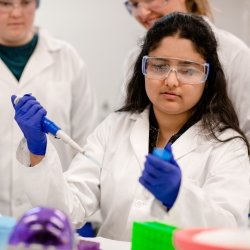
Demonstrate your hands-on science cognition. "Undergraduate inquiry experience really shines through on medical schoolhouse applications. Most medical schools want students who are interested in research, and the best way to show that interest is to come in having already gotten your feet wet" says Dr. Carlson. She did pipetting and ran assays for Dr. Pushpa Murthy'southward lab at Michigan Technological University. It was a minor function of the research, but she conveyed the overall bear upon. "I had to explain at my interviews that the larger telescopic of the research was near inositol phosphate metabolism."
Medical student Carly Joseph did long-term research in engineered biomaterials. "Sticking with it gave me fourth dimension to larn how to think critically and ignited my passion for science," she says. "I started off simply learning nigh biomaterials from older students in the lab, then gradually worked upwards to doing my own experiments and eventually presenting at conferences." Past choosing to brand research a master priority each semester she was able to form close relationships with kinesthesia mentors and attain more than during undergrad than she ever imagined.
In addition to college-based enquiry programs, you can investigate summer offerings, including those through the National Science Foundation Research Feel for Undergraduates program or bank check out the AAMC database for summer undergrad inquiry programs
three. Put in Time Serving Others
Dr. Carlson volunteered with the Big Brothers-Big Sisters organization. So did Joseph. Rake leaves, build an accessibility ramp, clean the beach, walk a dog. There are lots of non-clinical options for volunteering that demonstrate your willingness to pay information technology frontwards and give back.
"They accept many unlike programs and services." Joseph, accustomed into Primal Michigan University'south College of Medicine, was part of the Forever Friends programme, matched with an elderly adult female she visited a few times each month. "I 've formed a great friendship with her, and hopefully, helped alleviate some loneliness. It 'south a win-win!"
"Doctors are generally pretty altruistic people, and med schools want to see that you lot intendance well-nigh your customs or accept some drive to contribute to the greater good," says Dr. Carlson. "Community service comes in many forms, and actually anything qualifies, from trash cleanup and mentorship programs to working the concession stand up at a fund-raiser for a charity—anything that requires some unpaid time for a good cause."
Ask your pre-wellness professions advisor about volunteering opportunities on campus or in your customs, which could include helping at local food banks or blood drives, local shelters for the homeless or those dealing with domestic violence. You could tutor, deliver good companionship and Meals on Wheels, or walk the dogs at a local animate being shelter. Take an alternative spring break and work with Habitat for Humanity or on developing make clean water sources for Third World countries. Check with your school for a list of community and global partners it works with who can use your time and talents. The mentors y'all develop will come in handy when it'due south time to gather recommendation messages—nigh schools ask for at least 3—and the friendships you develop will last a lifetime.
4. Choose a Major You lot Will Excel In
Grades aren't everything, merely they're extremely important. Choose a subject that will yield a competitive GPA (grade point boilerplate). The recommended GPA for medical school applicants is three.7 for MDs (medical doctors), 3.5 for DOs (doctors of osteopathy), and iii.4 for NDs (Doctor of Naturopathic). While many students who are planning careers in medicine decide to major in biology, Dr. Carlson earned her available'southward in chemistry. Many of her colleagues majored in even more unexpected fields, including engineering, English language, music, and classics.
"It 's OK if you 're non on the pre-med track right abroad when you outset college; pursue experiences that genuinely involvement you and rely on guidance from your faculty mentors to navigate your path"
In that location is no such thing as a pre-med major, says pre-health professions advisor Nicole Seigneurie, who works with students preparing for medical careers at Michigan Technological University. "In that location are and then many different programs students tin can apply to." You will still demand to practise well in both your cumulative and your science GPA, classes similar biology, physics, chemistry, and math, that are required for medical school admission. If you are struggling in any classes, get help right away.
During her fourth twelvemonth, Joseph had to take many of the medical school prerequisite classes that were not part of her engineering curriculum and build a Medical College Admission Test (MCAT) written report programme into her schedule.
5. Apply to Multiple Schools

Better your odds by not placing all your hopes on one school. Do individual enquiry on each school, says Seigneurie; application requirements can vary from school to school and from yr-to-twelvemonth.
She also notes that you lot tin can reach out to admission committees with specific questions well-nigh the program and expectations. And, she says, don't exist bummed if at beginning you lot don't succeed. Attempt once more. "If you don 't get accepted into the school of your dreams, it 's OK! Schools have many applicants and can 't accept anybody," says McKenzie, who was accustomed into the Michigan State University College of Man Medicine. "My dad, who has been a family md for 29 years, often tells me, "An MD is an MD, it doesn't matter where you lot go to school."
"Don't take it personally when you go some rejections—they happen at every stage of the game. If you bandage a wide internet, you'll increase your likelihood of getting an credence."
Other means to get noticed among the hundreds or even thousands of medical school applications submitted each year: send supplemental materials beyond your application. For example, "if you've published a paper, consider sending a copy of the publication with a handwritten notation to the managing director of admissions, indicating you actually hope to be considered for acceptance," she says.
6. Study Early on and Often for the Medical Higher Admission Test, or MCAT
MCAT scores range from 472-528. Accustomed medical students average around 508. Recommended study time: 300-350 hours.
Accept a course and purchase books and report on your own. Find the method that works for y'all. Take do tests many times and don't allow your practice scores spook yous, says McKenzie. "I used the Kaplan book serial, and studied past reading, highlighting, and taking notes. The real MCAT was not as hard as the Kaplan test, in my opinion." The pre-health professions advisor can help you notice the resources you demand.
You tin can also join a pre-health professions club or association at your schoolhouse, including Alpha Epsilon Delta, the national honor society for health pre-professionals. Members help each other get gear up for tests, along with hosting speakers and events to help gain knowledge and feel.
vii. Learn Some other Language
"I speak Spanish almost every twenty-four hours at work," says Dr. Carlson. "It 's what I apply the most from my premed education." Joseph spent a semester in Chile. "Focusing on language, culture, and people challenged me in a me in means that technical classes couldn't and was critical in my preparation for medical school. If you 're thinking nearly studying away, do it. Communication and understanding unlike cultures are crucial skills for anyone entering the medical field, and medical schools expect for applicants who make the effort to broaden their horizons culturally."
Medical volunteer programs abroad are some other option to proceeds both life and health-intendance related experiences. Students are placed in hospitals and clinics in both rural and urban settings where staff is inadequate. Work, with professional guidance, can include giving vaccinations and other tasks interacting directly with patients, also as helping to make facilities cleaner and more accessible. Programs are normally for people aged eighteen and older
8. Don't Skimp on Extracurricular Activities

Show that y'all're interested in other things also schoolwork. Dr. Carlson says having outside interests makes you stand out (she plays violin in an orchestra). "It'southward OK to indicate some of these personal interests on your med schoolhouse applications—they requite the interviewers something to chronicle to you with," she says. "I interviewed one applicant who only got a C in biochemistry, but he wrote lots of letters to the admissions committee highlighting his other strengths. We accustomed him, and he turned out to be a star."
"Medical schools similar to see commitment in their applicants, be it to sports, piece of work, or extracurricular activities," says McKenzie. "It 's easier to not bring together clubs and just practice homework and relax, simply devoting fourth dimension now to extracurricular commitments is worth it in the long run. These experiences also give yous good opportunities to get to know people who tin can write the messages of recommendation."
Joseph says to choose activities based on what works best for you. Aim for quality rather than quantity.
"There 'south a lot of pressure to have as many leadership roles as possible and exist involved in tons of student organizations. For me though, having a few deep and lasting experiences was the manner to go. I chose to invest my time in enquiry, improving my Spanish, and volunteering," she says.
9. Be Polite and Be Yourself at Interviews
Enquiry the schools you lot're interested in and look at mission statements, and then you know something about the institution that you tin can share at the interview. Practice answering interview questions. When you arrive, be courteous to anybody you lot see at the interview, including the receptionist.
"Schools are interested in learning what kind of pupil and person you are," says McKenzie. Schools invest in students and are looking for a good fit.
If y'all need assist with constructive trunk linguistic communication, knowing how to dress professionally or for other tips, check out your school's Career Services office, which may offer mock interview opportunities and other techniques to assist you present your all-time cocky.
10. Exist Set up to Explain Why You Desire to be a Doctor

Avert generic answers similar "I want to help people." There'due south no one right answer. Be specific. Tell your story.
McKenzie'due south dream centers on helping people close to dwelling, in an underserved expanse that suffers from chronic doc shortages. "I accept always wanted to return to the Houghton-Hancock expanse, where I grew upwards, and to serve my rural community."
For Joseph, the dream centers on combining a passion for science with helping others in a direct way.
Dr. Carlson 's dream started when she was five years erstwhile and her sister was born with cystic fibrosis. She reminds applicants to become beyond that initial inspiration during application interviews and explain how yous've prepared for a grueling process that is not for everyone. "Afterward medical school comes residency, and then—for some—fellowship, academic rails positions, publications, and navigating an ever-evolving health care arrangement," says Dr. Carlson.
Bonus Tips for Getting into Medical School
Dr. Carlson has two more important suggestions to help you successfully utilise to medical school:
Inquire a Mentor or Advisor to Option Up the Phone and Brand a Phone call for Yous
"This is an unwritten rule that everyone does and nobody e'er told me until I was several years into my grooming," says Dr. Carlson. "If you want to go to a particular school, find a way to have ane of your mentors or advisors achieve out to the admissions commission on your behalf."
For example, if yous wanted to become to the University of Michigan ask your advisor or some other mentor to call the director of admissions or any other person they know and advocate for y'all. E-mail can also be effective, she says. "Information technology's a bonus if your mentor/advisor actually has a personal contact at the medical schoolhouse you're interested in. "At that place is a culture of 'I can vouch for this person' that goes very far in the medical world. A phone call won't become yous in if your awarding is terrible, but if you're on the cusp of credence and someone makes a call on your behalf, it can requite you the push button you need to be accepted."
Don't Be Afraid to Cocky-Promote (In a Apprehensive Way).
"Information technology'southward OK to highlight the accomplishments you're proud of; put these in your required personal statement or find a mode to piece of work them into conversation during interviews. The central is to do it humbly but confidently: 'I was fortunate plenty to win a teaching award from my time every bit a chemistry lab TA, and that'south something I'thou really proud of.' It'due south OK to be proud of your own achievements! Selectively highlighting a few brand your application stand out from the rest."
Do you lot have the personal skills information technology takes for a career in medicine?
Medical students must exist defended and focused. "A significant amount of personal sacrifice comes along with the training, and if you don't have a groovy motivation, you won't find the sacrifice worth the reward," says Dr. Carlson. If yous can answer yes to these questions, or you lot're willing to find the resource to work to develop whatever of these vital skills y'all could amend, you increase your chances of being able to attain what it takes to be accustomed into medical school.
Are y'all compassionate, mature, and emotionally intelligent?
Compassionate people are kind. They are aware of suffering in the self and other living things, and they want to help alleviate suffering. Mature people are able to accept responsibility. They are considerate of others, patient, and supportive of others, among other qualities. Emotionally intelligent people are aware of their emotions. They can harness and apply their emotions to trouble-solving and other tasks and manage emotions—like being able to cheer up yourself, or other people, or to infuse calm into a state of affairs.
Are yous hard-working?
Hard-working people are conscientious about correctly performing duties and tasks on fourth dimension. They are willing to put in the hours necessary to attain goals.
Are yous a high achiever?
Loftier-achieving people are motivated to set and complete ambitious goals. They have a passion to excel in the field they choose to work in and are not daunted by obstacles.
Are y'all socially conscious?
Socially witting people strive to stay informed and aware about the world around them, including how people interact with the economy, educational activity, and both physical and social environments.
Exercise you have excellent quantitative and qualitative skills?
People with quantitative skills can perform analyses and other physical and measurable tasks. Two examples of quantitative skills are data interpretation and math. People with qualitative skills are able to perform broad skills. Resilience and creativity are two examples of qualitative skills.
Pre-Health Professions at Michigan Tech
Michigan Tech's placement charge per unit into medical school is 60 to lxx percent (well above the national average) and is nearly 100 pct for concrete therapy schoolhouse. Cull a pre-health profession and ready for your future today.
Source: https://www.mtu.edu/pre-health/preparation/pre-medical/tips/
0 Response to "what to look at when looking at medical schools"
Post a Comment