Earliest Recording of You Know My Name by the Beatles
| Rockabilly | |
|---|---|
 | |
| Stylistic origins |
|
| Cultural origins | Early on to mid-1950s, Southern United States |
| Derivative forms | Garage stone |
| Fusion genres | |
| |
| Other topics | |
| |
Rockabilly is one of the primeval styles of rock and curl music. Information technology dates back to the early 1950s in the Usa, peculiarly the South. As a genre information technology blends the audio of Western musical styles such as country with that of rhythm and blues,[1] [2] leading to what is considered "classic" rock and roll.[3] Some take also described it as a alloy of bluegrass with rock and roll.[4] The term "rockabilly" itself is a portmanteau of "rock" (from "stone 'n' curl") and "hillbilly", the latter a reference to the country music (frequently called "hillbilly music" in the 1940s and 1950s) that contributed strongly to the manner. Other important influences on rockabilly include western swing, boogie-woogie, bound blues, and electric dejection.[5]
Defining features of the rockabilly audio included strong rhythms, song twangs, and common use of the tape echo;[6] but progressive addition of different instruments and vocal harmonies led to its "dilution".[2] Initially popularized by artists such equally Carl Perkins, Elvis Presley, Johnny Burnette, Jerry Lee Lewis and others, the rockabilly style waned in the tardily 1950s; nonetheless, during the tardily 1970s and early 1980s, rockabilly enjoyed a revival. An interest in the genre endures even in the 21st century, often within musical subcultures. Rockabilly has spawned a multifariousness of sub-styles and has influenced the evolution of other genres such as punk rock.[vi]
History [edit]
There was a close relationship between blues and country music from the very earliest country recordings in the 1920s. The first nationwide country hit was "Wreck of the Sometime 97",[7] [8] backed with "The Prisoner's Song", which as well became quite pop. Jimmie Rodgers, the "start true country star", was known every bit the "Blue Yodeler", and most of his songs used blues-based chord progressions, although with very different instrumentation and audio from the recordings of his black contemporaries like Blind Lemon Jefferson and Bessie Smith.[9]
During the 1930s and 1940s, two new sounds emerged. Bob Wills and his Texas Playboys were the leading proponents of Western Swing, which combined state singing and steel guitar with big ring jazz influences and horn sections; Wills's music found massive popularity. Recordings of Wills's from the mid 1940s to the early 1950s include "ii beat jazz" rhythms, "jazz choruses", and guitar work that preceded early on rockabilly recordings.[10] Wills is quoted as saying "Rock and Roll? Why, man, that's the same kind of music we've been playin' since 1928!... But it'due south but basic rhythm and has gone past a lot of unlike names in my time. It's the same, whether yous just follow a drum shell similar in Africa or surround it with a lot of instruments. The rhythm'southward what'south important."[11]
After dejection artists like Meade Lux Lewis and Pete Johnson launched a nationwide boogie craze starting in 1938, state artists like Moon Mullican, the Delmore Brothers, Tennessee Ernie Ford, Speedy West, Jimmy Bryant, and the Maddox Brothers and Rose began recording what was then known equally "hillbilly boogie", which consisted of "hillbilly" vocals and instrumentation with a boogie bass line.[12]
After World War 2, The Maddox Brothers and Rose were at "the leading edge of rockabilly with the slapped bass that Fred Maddox had developed".[13] [fourteen] They had shifted into higher gear leaning toward a whimsical honky-tonk experience, with a heavy, manic lesser end and loftier volume.[xv] The Maddoxes were known for their lively, antic-filled shows, which were an influential novelty for white listeners and musicians akin.[16] [17]
Along with country, swing and boogie influences, spring blues artists such equally Wynonie Harris and Roy Brownish, and electric blues acts such as Howlin' Wolf, Junior Parker, and Arthur Crudup, influenced the development of rockabilly.[five] The Memphis blues musician Junior Parker and his electric dejection band, Little Junior's Blueish Flames, featuring Pat Hare on the guitar, were a major influence on the rockabilly style, particularly with their songs "Beloved My Babe" and "Mystery Railroad train" in 1953.[18] [19]
Zeb Turner's Feb 1953 recording of "Jersey Rock" with its mix of musical styles, lyrics about music and dancing, and guitar solo,[20] is another case of the mixing of musical genres in the start one-half of the 1950s.
Bill Monroe is known as the Male parent of Bluegrass, a specific style of country music. Many of his songs were in dejection form, while others took the course of folk ballads, parlor songs, or waltzes. Bluegrass was a staple of country music in the early on 1950s and is often mentioned as an influence in the development of rockabilly, in function owing to its favouring of fast tempos.[21]
The Honky Tonk sound, which "tended to focus on working-form life, with frequently tragic themes of lost beloved, adultery, loneliness, alcoholism, and cocky-pity", besides included songs of energetic, uptempo Hillbilly Boogie. Some of the meliorate known musicians who recorded and performed these songs are: the Delmore Brothers, the Maddox Brothers and Rose, Merle Travis, Hank Williams, Hank Snow, and Tennessee Ernie Ford.[22]
Tennessee [edit]
Sharecroppers' sons Carl Perkins and his brothers Jay and Clayton, forth with drummer W. S. Holland, had established themselves as one of the hottest bands on the honky-tonk excursion around Jackson, Tennessee. Near of the songs they played were country standards with a faster rhythm.[23] Information technology was here that Carl started composing his outset songs. While playing, he would watch the dance floor to see what the audience preferred and adjust his compositions to adapt, writing them downwards only when he was certain they were finished. Carl sent numerous demos to New York tape companies with no success; the producers believed the Perkins' style of rhythmically-driven state was non commercially feasible. That would modify in 1955[24] [25] after recording the song "Blue Suede Shoes" (recorded Dec xix, 1955) on Sam Phillips' Memphis-based Sunday Records. Subsequently made more famous by Elvis Presley, Perkins' original version was an early rock 'n' scroll standard.[26] [27]
In the early 1950s there was heavy competition amid Memphis area bands playing an audience-savvy mix of covers, original songs, and hillbilly flavored blues. Ane source mentions both local disc jockey Dewey Phillips and producer Sam Phillips every bit being influential.[28] An early radio evidence on KWEM in West Memphis, Arkansas quickly became a mix of blues, state and early on rockabilly.[29] [30] The Saturday Night Jamboree was a Memphis phase show held every Saturday nighttime at the Goodwyn Plant Auditorium in downtown Memphis, Tennessee from 1953–1954. The Jamboree shows were sometimes circulate live on KWEM. A number of future notables performed there, including Elvis Presley.[31] The performers often experimented with new sounds in their dressing rooms, incorporating the best ones into their shows.[32]
In 1951 and 1952 brothers Johnny and Dorsey Burnette, as well equally Paul Burlison, played a blend of dejection, country, and rockabilly at live shows in and around the Memphis area.[29] [thirty] in 1953, they played with Doc McQueen'south swing band at the Hideaway Lodge for a time. While there, they wrote a song called "Stone Baton Boogie", named after the Burnette brothers' sons Rocky and Billy (Rocky Burnette later became a stone and curlicue star in his ain right), although they did not record the song until 1957.[33] [34] The Burnettes disliked the popular music McQueen played, so they began playing smaller shows on their own, focusing on their budding rockabilly audio.[33] The trio released "Train Kept A-Rollin'" in 1956, listed by Rolling Stone magazine as one of the acme 500 rock songs of all fourth dimension. Many consider this 1956 recording to be the first intentional use of a distortion upshot on a stone song, which was played past atomic number 82 guitarist Paul Burlison.[ commendation needed ]
Elvis Presley [edit]

Elvis Presley's first recordings took place at Sunday Records, a small contained characterization run by record producer Sam Phillips in Memphis, Tennessee.[35] For several years, Phillips had been recording and releasing performances by dejection and country musicians in the expanse. He also ran a service allowing anyone to come in off the street and for a modest fee, record themselves on a two-vocal vanity tape. One young human being who came to record himself as a surprise for his mother, he claimed, was Elvis Presley.[36]
Presley made enough of an impression that Phillips deputized guitarist Scotty Moore, who and so enlisted bassist Bill Blackness, both from the Starlight Wranglers, a local western swing ring, to work with the young man.[37] The trio rehearsed dozens of songs, from traditional country to gospel.[38] During a break on July 5, 1954, Elvis started playing "That'due south All Correct Mama", a 1946 blues vocal by Arthur Crudup, and Moore and Black joined in. Later several takes, Phillips had a satisfactory recording. "That's All Right" was released on July xix, 1954.[37] [39]
Presley'southward version of "That'due south All Right Mama" melded country, a genre associated with white culture, and rhythm & blues, a genre associated with black culture. The resulting track was denied airplay on both country radio stations and R&B stations for being "also blackness" and "too white", respectively. Country deejays told Phillips they would be "run out of town" for playing it.[ citation needed ] When the song was finally played by one rogue disk, Dewey Phillips,[35] Presley's recording created so much excitement it was described as having waged state of war on segregated radio stations.[ citation needed ]
All of Presley'due south early singles featured a blues song on one side and a country song on the other, both sung in the same genre-blending style.[40] Presley's Sun recordings feature his vocals and rhythm guitar, Nib Black's percussive slapped bass, and Scotty Moore on an amplified guitar. Slap bass had been a staple of both western swing and hillbilly boogie since the 1940s. Scotty Moore described his playing way equally an amalgamation of techniques he had picked up from other guitarists over the years.[41] Presley's unique musical mode rocketed him into the spotlight, and drew masses of followers.[42]
Nobody was sure what to call Presley's music, so Elvis was described as "The Hillbilly Cat" and "King of Western Bop". Over the next year, Elvis would record four more than singles for Dominicus. Rockabilly recorded by artists prior to Presley can exist described as beingness in the long-continuing country fashion of Rockabilly. Presley's recordings are described by some equally quintessential rockabilly for their truthful union of country and R&B, which can exist described every bit the truthful realization of the Rockabilly genre. In addition to the fusion of singled-out genres, Presley's recordings contain some traditional likewise as new traits: "nervously upward tempo" (every bit Peter Guralnick describes it), with slap bass, fancy guitar picking, much echo, shouts of encouragement, and vocals full of histrionics such equally hiccups, stutters, and swoops from falsetto to bass and back over again.[43] [44]
By end of 1954 Elvis asked D.J. Fontana, the drummer for the Louisiana Hayride, to join him for future dates.[45] By that time, many rockabilly bands were incorporating drums, which distinguished the audio from country music, where they were and then uncommon. In the 1956 sessions shortly later Presley's move from Sun Records to RCA, Presley was backed past a band that included Moore, Black, Fontana, and pianist Floyd Cramer.[46] In 1956 Elvis also caused vocal backup via the Jordanaires.[47]
North of the Mason-Dixon Line [edit]

In 1951 a western swing bandleader named Bill Haley recorded a version of "Rocket 88" with his group, the Saddlemen. It is considered ane of the earliest recognized rockabilly recordings.[48] It was followed past versions of "Rock the Joint" in 1952, and original works such as "Existent Rock Drive" and "Crazy Human, Crazy", the latter of which reached number 12 on the American Billboard chart in 1953.[49] [50] On Apr 12, 1954, Haley, performing with his band as Bill Haley and His Comets, recorded "Stone Around the Clock" for Decca Records of New York City. When first released in May 1954, "Rock Around the Clock" fabricated the charts for one week at number 23, and sold 75,000 copies.[51] In 1955, it was featured in the pic Blackboard Jungle, resulting in a resurgence of sales.[52] The song hit No. 1, held that position for eight weeks, and was the number two song on the Billboard Hot 100 chart for 1955.[53] The recording was, until the belatedly 1990s, recognized by Guinness World Records as having the highest sales claim for a pop vinyl recording, with an "unaudited" claim of 25 1000000 copies sold.[54]
Maine native and Connecticut resident Bill Flagg began using the term rockabilly for his combination of rock 'northward' roll and hillbilly music as early every bit 1953.[55] He cut several songs for Tetra Records in 1956 and 1957.[56] "Go Cat Go" went into the National Billboard charts in 1956, and his "Guitar Stone" is cited as classic rockabilly.[55]
In 1953, 13-year-onetime Janis Martin was performing at the Onetime Rule Befouled Dance on WRVA out of Richmond, Virginia.[57] [58] Martin performed a mix of country songs for the bear witness peppered with rhythm and blues hits in a style that has been described equally "proto-rockabilly".[59] She later stated, "the audience didn't know what to brand of it. They didn't hardly allow electric instruments, and I was doing some songs past black artists."[59]
Greenbacks, Perkins and Presley [edit]
In 1954, both Johnny Cash and Carl Perkins auditioned for Sam Phillips. Greenbacks hoped to record gospel music, but Phillips wasn't interested. In Oct 1954, Carl Perkins recorded Perkins'southward original song "Movie Magg", which was released in March 1955 on Phillips's all-country label Flip.[threescore] Cash returned to Lord's day in 1955 with his song "Hey, Porter", and his grouping the Tennessee Three. This song and another Greenbacks original, Cry! Cry! Cry! were released in July.[61] Cry! Cry! Cry! managed to crevice Billboard's Meridian twenty, peaking at No. 14.[62]
Presley'due south 2nd and third singles were not as successful as his get-go.[63] His quaternary release, "Baby, Let's Play Firm", was released in May 1955, and peaked at number five on the national Billboard Country Chart.[64] In August, Sun released Elvis'due south versions of "I Forgot to Remember to Forget" and "Mystery Train". "Retrieve to Forget" spent a total of 39 weeks on the Billboard Country Chart, v at the number one spot. "Mystery Railroad train", peaked at number 11.[ commendation needed ]
Through most of 1955, Cash, Perkins, Presley, and other Louisiana Hayride performers toured through Texas, Arkansas, Oklahoma, Louisiana and Mississippi. Sun released ii more than Perkins songs in October: "Gone, Gone, Gone" and "Let the Jukebox Keep on Playing".[65] Perkins and Presley in item competed as the premier rockabilly artists.[66]
1955 was also the year in which Chuck Berry'southward hillbilly-influenced unmarried "Maybellene" reached high in the charts every bit a crossover hit, and Neb Haley and His Comets' "Rock Around the Clock" was not only number one for eight weeks, only was the number two record for the year.[53] Rock and roll in full general, and rockabilly in item, was at critical mass and the next year, Elvis Presley's Heartbreak Hotel and Don't Be Cruel would elevation the Billboard Charts also.[67]
Rockabilly goes national: 1956 [edit]
In January 1956, iii now-classic rockabilly songs were released: "Folsom Prison Dejection" by Johnny Cash, and "Blue Suede Shoes" by Carl Perkins, both on Sun; and "Heartbreak Hotel" by Elvis Presley on RCA.[68] [69] Perkins's "Blue Suede Shoes" sold 20,000 records a twenty-four hours at one indicate, and it was the first meg-selling country song to cantankerous over to both rhythm and blues and popular charts.[70] Perkins first performed "Blue Suede Shoes" on television March 17 on Ozark Jubilee, a weekly ABC-TV program. From 1955 to 1960, the alive national radio and TV show from Springfield, Missouri featured Brenda Lee and Wanda Jackson and guests included Cistron Vincent and other rockabilly artists.[ citation needed ] On February eleven, Presley appeared on the Dorsey Brothers' Stage Show for the 3rd fourth dimension, singing "Blueish Suede Shoes" and "Heartbreak Hotel". Both songs topped the Billboard charts.[67]
Sunday and RCA weren't the merely record companies releasing rockabilly music in 1956. In March Columbia released "Honky Tonk Man" by Johnny Horton,[71] King put out "Seven Nights to Rock" by Moon Mullican, Mercury issued "Rockin' Daddy" by Eddie Bond,[72] and Starday released Bill Mack's "Fat Woman".[73] Two young men from Texas made their record debuts in April 1956: Buddy Holly on the Decca label, and, every bit a fellow member of the Teen Kings, Roy Orbison with "Ooby Dooby" on the New United mexican states/Texas based Je-wel label.[74] Holly's large hits would not be released until 1957. Janis Martin was only fifteen years erstwhile when RCA issued a record with "Will Yous, Willyum" and the Martin-equanimous "Drugstore Rock 'n' Roll", which sold over 750,000 copies.[75] King records issued a new deejay past forty-seven-year-quondam Moon Mullican: "Seven Nights to Rock" and "Stone 'N' Ringlet Mr. Bullfrog". Twenty more sides were issued by diverse labels including 4 Star, Blue Hen, Dot, Cold Bond, Mercury, Reject, Democracy, Rodeo, and Starday.[76]
In April and May 1956, The Stone and Curl Trio played on Ted Mack'southward Television talent show in New York City. They won all three times and guaranteed them a finalist position in the September supershow.[33] Gene Vincent and His Blue Caps' recording of "Be-Bop-A-Lula" was released on June 2, 1956, backed past "Woman Honey". Inside xx-one days information technology sold over 2 hundred thou records, stayed at the top of national pop and land charts for twenty weeks, and sold more than a million copies.[77] [78] [79] These same musicians would have 2 more releases in 1956, followed by some other in Jan 1957. "Queen of Rockabilly" Wanda Jackson's commencement tape came out in July, "I Gotta Know" on the Capitol label; followed by "Hot Dog That Fabricated Him Mad" in November. Capitol would release nine more records by Jackson, some with songs she had written herself, before the 1950s were over.[eighty] [81] The first tape by Jerry Lee Lewis, who would later be known equally a pioneer of rockabilly and rock and scroll, came out on December 22, 1956, and featured his version of "Crazy Arms" and "Terminate of the Road".[82] Lewis would have big hits in 1957 with his version of "Whole Lotta Shakin' Goin' On", issued in May, and "Groovy Assurance Of Fire" on Lord's day.[26] [83]
Belatedly 1950s and beyond [edit]
In that location were thousands of musicians who recorded songs in the rockabilly mode, and many record companies released rockabilly records.[84] Some enjoyed major chart success and were of import influences on futurity rock musicians.
Sun also hosted performers, such as Billy Lee Riley, Sonny Burgess, Charlie Feathers, and Warren Smith. There were besides several female performers like Wanda Jackson who recorded rockabilly music long subsequently the other ladies, Janis Martin, the female Elvis Jo Ann Campbell, and Alis Lesley, who also sang in the rockabilly style. Mel Kimbrough -"Slim", recorded "I Get Lonesome Too"[85] and "Ha Ha, Hey Hey" for Glenn Records forth with "Dear in W Virginia" and "Land Rock Sound" for Checkmate a sectionalisation of Caprice Records.[86]
Gene Summers, a Dallas native and Rockabilly Hall of Fame inductee, released his classic Jan/Jane 45s in 1958–59. He continued to record rockabilly music well into 1964 with the release of "Alabama Shake".[87] In 2005, Summers's most popular recording, School of Stone 'north Roll, was selected by Bob Solly and Tape Collector Magazine equally 1 of the "100 Greatest Stone 'n' Roll Records".[88]
Tommy "Sleepy LaBeef" LaBeff recorded rockabilly tunes on a number of labels from 1957 through 1963.[89] Rockabilly pioneers the Maddox Brothers and Rose continued to record for decades.[ninety] [91] Withal, none of these artists had any major hits and their influence would non be felt until decades later.[92]
In the summer of 1958 Eddie Cochran had a chart-topping hit with "Summertime Blues". Cochran's brief career included only a few more hits, such as "Sitting in the Balustrade" released in early 1957, "C'mon Everybody" released in October 1958, and "Somethin' Else" released in July 1959. Then in April 1960, while touring with Gene Vincent in the United kingdom of great britain and northern ireland, their taxi crashed into a concrete lamp mail, killing Eddie at the young age of 21. The grim coincidence in this all was that his posthumous U.k. number-i striking was chosen "Iii Steps to Heaven".
Rockabilly music enjoyed bully popularity in the The states during 1956 and 1957, simply radio play declined after 1960. Factors contributing to this decline are usually cited as the 1959 decease of Buddy Holly in an airplane crash (forth with Ritchie Valens and the Large Bopper), the consecration of Elvis Presley into the army in 1958, and a general change in American musical tastes. The mode remained popular longer in England, where it attracted a fanatical following right up through the mid-1960s.
Rockabilly music cultivated an attitude that bodacious its enduring appeal to teenagers. This was a combination of rebellion, sexuality, and liberty—a sneering expression of disdain for the workaday world of parents and authority figures. It was the showtime rock 'n' ringlet way to exist performed primarily by white musicians, thus setting off a cultural revolution that is still reverberating today.[93] [94] "Rockabilly" deviance from social norms, however, was more symbolic than existent; and eventual public professions of faith by aging rockabillies were non uncommon.[95]
Apply of the term "rockabilly" [edit]
Early rockabilly singer Barbara Pittman told Experience Music Project that "Rockabilly was actually an insult to the southern rockers at that time. Over the years it has picked upwards a little dignity. Information technology was their way of calling us 'hillbillies'."[ citation needed ]
Ane of the kickoff written uses of the term rockabilly was in a press release describing Factor Vincent's "Be-Bop-A-Lula".[96] Three weeks later, it was also used in a June 23, 1956, Billboard review of Ruckus Tyler'southward "Rock Boondocks Stone".[97]
The first tape to contain the give-and-take rockabilly in a song title was "Rock a Billy Gal", issued in Nov 1956.[98] The Burnette brothers had been playing a song called "Stone Billy Boogie" since 1953, but did not record or release it until 1956 and 1957, respectively.[33] [34]
Characteristic sound and techniques [edit]
Some furnishings and techniques strongly associated with rockabilly as a style include slapback, slapback echo, flutter echo, tape delay repeat, echo, and reverb.
The distinctive reverberation on the early hit records such as "Stone Around The Clock" by Bill Haley & His Comets was created by recording the band under the domed ceiling of Decca's studio in New York, located in an echoing sometime ballroom chosen The Pythian Temple. This aforementioned studio would likewise be used to tape other rockabilly musicians such as Buddy Holly and The Stone and Ringlet Trio.[33] [99] Memphis Recording Services Studio, where Sam Phillips recorded, had a sloped ceiling covered with corrugated tiles. This created some of the desired resonance, but Phillips used technical methods to create additional echo: the original signal from one tape machine was fed through a second machine with a dissever-second delay.[100] [101] The echo result was noticeable on Wilf Carter records from the 1930s and in Eddy Arnold's "Cattle Call" (1945).[101] When Elvis Presley left Phillips' Sun Records and recorded "Heartbreak Hotel" for RCA, the RCA producers placed microphones at the cease of a hallway to achieve a like upshot.[ citation needed ] The echoing sound created the impression of a live testify.[102]
In comparison to country songs, rockabilly songs generally take simplified class, lyrics, chord progressions and arrangements, faster tempos, and amplified percussion. At that place is greater variability in lyrics and melodies, and the singing way is more flamboyant.[103] Compared to rhythm and blues, fewer instruments are used, but percussion is amplified to fill out the sound. The singing mode is less smoothen and mannered.[103]
Influence on the Beatles and the British Invasion [edit]
The starting time wave of rockabilly fans in the United Kingdom were chosen Teddy Boys because they wore long, Edwardian-manner frock coats, forth with tight black drainpipe trousers and brothel creeper shoes. Another group in the 1950s that were followers of rockabilly were the Ton-Up boys, who rode British motorcycles and would after be known every bit rockers in the early 1960s. The rockers had adopted the classic greaser look of T-shirts, jeans, and leather jackets to become with their heavily slicked pompadour haircuts. The rockers loved 1950s stone and roll artists such equally Cistron Vincent, and some British rockabilly fans formed bands and played their own version of the music.
The most notable of these bands was The Beatles. When John Lennon first met Paul McCartney, he was impressed that McCartney knew all the chords and the words to Eddie Cochran's "Twenty Flight Rock". Every bit the band became more professional and began playing in Hamburg, they took on the "Beatle" name (inspired by Buddy Holly'southward band The Crickets[104]) and they adopted the black leather wait of Gene Vincent. Musically, they combined Holly's melodic songwriting sensibility with the rough rock and whorl sound of Vincent and Carl Perkins. When The Beatles became worldwide stars, they released versions of three different Carl Perkins songs, more whatsoever other songwriter outside the band, except Larry Williams, who besides added three songs to their discography.[105] (Curiously, none of these iii were sung by the Beatles' regular lead vocalists—"Honey Don't" (sung by Ringo) and "Everybody's Trying to be my Baby" (sung by George) from Beatles for Sale (1964) and "Matchbox" (sung past Ringo) on the Long Alpine Sally EP (1964)).
Long after the band bankrupt up, the members continued to show their interest in rockabilly. In 1975, Lennon recorded an album called Rock 'n' Roll, featuring versions of rockabilly hits and a cover photograph showing him in full Gene Vincent leather. About the same time, Ringo Starr had a hitting with a version of Johnny Burnette'southward "You lot're Xvi". In the 1980s, McCartney recorded a duet with Carl Perkins, and George Harrison collaborated with Roy Orbison in the Traveling Wilburys. In 1999, McCartney released Run Devil Run, his own tape of rockabilly covers.[106]
The Beatles were not the simply British Invasion artists influenced past rockabilly. The Rolling Stones recorded Buddy Holly's "Not Fade Away" on an early single and later a rockabilly-manner song, "Rip This Articulation", on Exile on Main St. The Who, despite being mod favourites, covered Eddie Cochran's "Summertime Dejection" and Johnny Kidd and The Pirates' Shakin' All Over on their Alive at Leeds anthology. Even heavy guitar heroes such every bit Jeff Beck and Jimmy Page were influenced by rockabilly musicians. Beck recorded his own tribute album to Gene Vincent's guitarist Cliff Gallup—Crazy Legs—and Page'due south band, Led Zeppelin, offered to work as Elvis Presley's backing band in the 1970s. Nevertheless, Presley never took them upward on that offer.[107] Years afterward, Led Zeppelin's Page and Robert Constitute recorded a tribute to the music of the 1950s called The Honeydrippers: Volume One. [ citation needed ]
Rockabilly revival: 1970–1990 [edit]

Gazzguzzlers use the classic instruments associated with rockabilly: a hollow-body guitar, an upright bass, and a pared-down drum kit.
The 1968 Elvis "comeback" and acts such as Sha Na Na, Creedence Clearwater Revival, Don McLean, Linda Ronstadt and the Everly Brothers, the movie American Graffiti, the television testify Happy Days and the Teddy Boy revival created curiosity nearly the real music of the 1950s, especially in England, where a rockabilly revival scene began to develop from the 1970s in record collecting and clubs.[108] [109] The most successful early product of the scene was Dave Edmunds, who joined upwardly with songwriter Nick Lowe to grade a band chosen Rockpile in 1975. They had a string of pocket-sized rockabilly-style hits like "I Knew the Bride (When She Used to Rock 'due north' Roll)". The grouping became a popular touring act in the Uk and the US, leading to respectable anthology sales. Edmunds likewise nurtured and produced many younger artists who shared his honey of rockabilly, well-nigh notably the Devious Cats.[110]
Robert Gordon emerged from late 1970s CBGB punk act Tuff Darts to reinvent himself every bit a rockabilly revival solo artist. He recorded commencement with 1950s guitar legend Link Wray and later with UK studio guitar veteran Chris Spedding and found borderline mainstream success. Likewise festering at CBGB's punk environs were The Cramps, who combined primitive and wild rockabilly sounds with lyrics inspired by old drive-in horror movies in songs like "Homo Fly" and "I Was a Teenage Werewolf". Pb singer Lux Interior's energetic and unpredictable live shows attracted a fervent cult audience. Their "psychobilly" music influenced The Meteors and Reverend Horton Heat. In the early '80s, the Latin genre was born in Colombia by Marco T (Marco Tulio Sanchez), with The Gatos Montañeros.[111] The Polecats, from N London, were originally chosen The Cult Heroes; they couldn't become whatever gigs at rockabilly clubs with a proper name that sounded "punk", so the original drummer Chris Hawkes came up with the name "Polecats". Tim Polecat and Boz Boorer started playing together in 1976, and then hooked up with Phil Bloomberg and Chris Hawkes at the stop of 1977. The Polecats played rockabilly with a punk sense of anarchy and helped revive the genre for a new generation in the early 1980s.
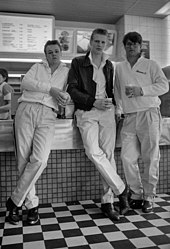
Teddy & The Tigers, a Finnish rockabilly band from Kerava, pictured in Helsinki, 1978
The Blasters, who emerged from the Los Angeles punk scene, included rockabilly among their roots rock influences. The song "Marie Marie", first appearing on their 1980 debut album American Music, would afterward become a quantum hit for Shakin' Stevens.
As well in 1980, Queen scored a number-one hit on the Billboard Hot 100 with the rockabilly-inspired single "Crazy Niggling Matter Chosen Love".[112]
The Stray Cats were the near commercially successful of the new rockabilly artists. The band formed on Long Island in 1979 when Brian Setzer teamed upwardly with two schoolhouse chums calling themselves Lee Rocker and Slim Jim Phantom. Attracting petty attention in New York, they flew to London in 1980, where they had heard that there was an active rockabilly scene. Early shows were attended by the Rolling Stones and Dave Edmunds, who rapidly ushered the boys into a recording studio. The Stray Cats had iii U.k. Pinnacle X singles to their credit and two all-time-selling albums. They returned to the US, performing on the TV show Fridays with a message flashing beyond the screen that they had no tape bargain in united states.
Presently EMI picked them up, their first videos appeared on MTV, and they stormed up the charts stateside. Their third LP, Bluster 'North' Rave with the Devious Cats, topped charts across the US and Europe as they sold-out shows everywhere during 1983. However, personal conflicts led the band to pause upwards at the height of their popularity. Brian Setzer went on to solo success working in both rockabilly and swing styles, while Rocker and Phantom continued to record in bands both together and singly. The group has reconvened several times to make new records or tours and continue to attract big audiences live, although tape sales accept never again approached their early on '80s success.[113]
The Jime[114] entered the rockabilly scene in 1983, when Vince Gordon formed his band. The Jime[115] was a Danish Band. The Jime was the band of Vince Gordon, rockabilly guitarist. Not only was he the nerve of the band, Vince Gordon was the ring. He equanimous about all its songs and hits. Vince Gordon also left his mark on the rockabilly scene in many ways. Expert Fred Sokolow[116] talks most the Vince Gordon style in Rockabilly due to his composing. Vince Gordon had many different musicians in his band. The lifetime of the Jime ended with the decease of Vince Gordon in 2016.
Shakin' Stevens was a Welsh singer who gained fame in the U.k. portraying Elvis in a stage play. In 1980, he took a cover of The Blasters' "Marie Marie" into the UK Top xx. His hopped-upwards versions of songs like "This Ole House" and "Green Door" were behemothic sellers across Europe. Shakin' Stevens was the biggest selling singles artist of the 1980s in the UK (with 4 number ones in the singles chart)[117] and number two across Europe, outstripping Michael Jackson, Prince, and Bruce Springsteen. Unlike The Stray Cats, who became successful due in part to MTV, Shakin' Stevens' success was initially due to him actualization on various children'due south boob tube shows in Britain.[118] Despite his popularity in Europe, he never became a large success in the Usa. In 2005, his greatest hits album The Collection reached number four in the British albums chart, and was released as a tie-in to his appearance on ITV entertainment show Hit Me, Baby, I More Time, going on to go the winner of the series.[119] [120] [121] Other notable British rockabilly bands of the 1980s included The Jets, Crazy Cavan, Matchbox, and the Rockats.[122]
Jason & the Scorchers combined heavy metallic, Chuck Berry and Hank Williams to create a punk-influenced style of rockabilly, frequently labelled as alt-land or cowpunk. They accomplished critical acclamation and a post-obit in America but never managed a major hit.[123]
The revival was related to the "roots stone" movement, which continued through the 1980s, led by artists similar James Intveld, who afterward toured equally lead guitar for The Blasters, High Apex, the Beat Farmers, The Paladins, Forbidden Pigs, Del-Lords, Long Ryders, The Last Wild Sons, The Fabulous Thunderbirds, Los Lobos, The Fleshtones, Del Fuegos, Reverend Horton Heat and Barrence Whitfield and the Savages. These bands, like the Blasters, were inspired by a full range of historic American styles: dejection, country, rockabilly, R&B and New Orleans jazz. They held a potent appeal for listeners who were tired of the commercially oriented MTV-fashion synthpop and glam metal bands that dominated radio play during this fourth dimension period, but none of these musicians became major stars.[124]
In 1983, Neil Young recorded a rockabilly anthology titled Everybody's Rockin'. The album was not a commercial success[ citation needed ] and Young was involved in a widely publicized legal fight with Geffen Records who sued him for making a record that didn't audio "like a Neil Young tape".[ citation needed ] Young fabricated no further albums in the rockabilly fashion.[125] During the 1980s, a number of state music stars scored hits recording in a rockabilly style. Marty Stuart's "Hillbilly Rock" and Hank Williams, Jr.'s "All My Rowdy Friends Are Coming Over Tonight" were the virtually noteworthy examples of this tendency, but they and other artists similar Steve Earle and the Kentucky Headhunters charted many records with this arroyo.[126]
Rockabilly dancers in Nippon, 2016
Neo-rockabilly (1990–nowadays) [edit]
While not true rockabilly, many contemporary indie pop, blues stone, and country rock groups from the US, like Kings of Leon, Black Keys, Blackfoot, and the White Stripes,[127] were heavily influenced by rockabilly.[128]
Morrissey adopted a rockabilly style during the early 1990s, being largely influenced past his guitarists Boz Boorer and Alain Whyte and working with erstwhile Fairground Attraction bass-guitarist and songwriter Mark East. Nevin.[ commendation needed ] His rockabilly style was emphasised in the singles "Significant for the Last Fourth dimension" and "Sing Your Life", as well as his second solo album and tour Impale Uncle.
Irish rockabilly creative person Imelda May has been partly responsible for a resurgence of European interest in the genre, scoring three successive number i albums in Ireland, with ii of those as well reaching the top x in the Britain charts.
UK creative person Jimmy Ray incorporated themes and aesthetics of rockabilly music into his image likewise as his 1998 hit, Are You Jimmy Ray?, which Ray described as "popabilly hip hop".[129]
Vocaliser-songwriter and role player Drake Bell recorded an anthology of rockabilly covers, Ready Steady Become!, in 2014. The album was produced past Brian Setzer, frontman of the rockabilly revival band The Stray Cats. The album sold over ii,000 copies in its outset week of release, peaking at #182 on the Billboard 200, and received positive reviews from critics.
Neo-rockabilly UK band Restless, have played neo-rockabilly since the early on 1980s. The fashion was to mix whatsoever popular music to a rockabilly fix, drums, slap bass and guitar. This was followed by many other artists at the time in London. Today, bands like Lower The Tone are more than aligned to neo-rockabilly that suits popular music venues instead of the dedicated rockabilly clubs that wait only original rockabilly.[130] [131]
Rockabilly Hall of Fame [edit]
The original Rockabilly Hall of Fame was established past Bob Timmers on March 21, 1997, to present early rock and roll history and data relative to the original artists and personalities involved in this pioneering American music genre. It is headquartered in Nashville.[132]
In 2000, an International Stone-A-Baton Hall of Fame Museum was established in Jackson, Tennessee.[133]
See also [edit]
- Listing of rockabilly musicians
- Bluegrass music
- Boogie stone
- Folk music
- Folk rock
- Gothabilly
- Psychobilly
References [edit]
- ^ "ROCKABILLY Definition". Shsu.edu . Retrieved Baronial 22, 2015.
- ^ a b Craig Morrison (November 21, 2013). "rockabilly (music) - Encyclopædia Britannica". Britannica.com. Retrieved May 22, 2014.
- ^ "ROCKABILLY Definition". Shsu.edu. Retrieved May 22, 2014.
- ^ The American Heritage® Lexicon of the English Language, Fourth Edition copyright ©2000 by Houghton Mifflin Visitor. Updated in 2009. Published by Houghton Mifflin Company.
- ^ a b Vladimir Bogdanov, Chris Woodstra, Stephen Thomas Erlewine, All Music Guide to Country: The Definitive Guide to Country Music, page 912 [ dead link ]
- ^ a b "Fundamentals of Rockabilly". Guitar.com. Archived from the original on July half dozen, 2014. Retrieved May 22, 2014.
- ^ "Old97song folio". Blueridgeinstitute.org. Retrieved May 22, 2014.
- ^ "Old97 page". Blueridgeinstitute.org. Retrieved May 22, 2014.
- ^ Mystery Train: Images of America in Rock 'n' Curlicue Music by Greil Marcus 1982 E.P. Dutton p.291
- ^ San Antonio Rose: The Life and Music of Bob Wills. Charles R. Townsend. 1976. Academy of Illinois. Folio 289. ISBN 0-252-00470-i
- ^ San Antonio Rose: The Life and Music of Bob Wills. Charles R. Townsend. 1976. University of Illinois. Page 269. ISBN 0-252-00470-one
- ^ Country: The Twisted Roots of Stone & Gyre by Nick Tosches 1996 Da Capo Press
- ^ "NPR's series of chronicles on American Music". Npr.org. Archived from the original on September 14, 2013. Retrieved May 22, 2014.
- ^ "NPR podcast". Npr.org. Retrieved May 22, 2014.
- ^ Workin' Man Blues: Country Music in California. Gerald Due west. Haslan. University of California Press. 1999. Pages 170, 171. ISBN 0-520-21800-0.
- ^ Workin' Man Dejection: Land Music in California. Gerald W. Haslan. University of California Printing. 1999. Page 170. ISBN 0-520-21800-0.
- ^ Workin' Man Dejection: Country Music in California. Gerald Due west. Haslan. University of California Press. 1999. Folio 132. ISBN 0-520-21800-0.
- ^ Junior Parker at AllMusic
- ^ Gillett, Charlie (1984). The sound of the city: the rise of stone and ringlet (Rev. ed.). New York: Pantheon Books. ISBN0394726383 . Retrieved July 6, 2012.
"Dear My Baby" in particular featured some blistering guitar playing by Pat Hare, which inspired the rockabilly fashion discussed elsewhere.
- ^ "RCS page for Zeb Turner". Rcs-discography.com. Retrieved May 22, 2014. [ permanent dead link ]
- ^ Bluegrass Breakdown: The Making of the Old Southern Sound by Robert Cantwell 1992 Da Capo Press ISBN 0-252-07117-iv
- ^ "The Roots of Rock 'north' Scroll 1946–1954" 2004 Universal Music Enterprises
- ^ The Rockabilly Legends: They Called It Rockabilly Long Before they Called It Rock and Roll by Jerry Naylor and Steve Halliday ISBN 978-one-4234-2042-2
- ^ "Rolling Rock : Carl Perkins: Biography". Rolling Stone. Apr 9, 2007. Archived from the original on April 9, 2007.
- ^ "RAB Hall of Fame: Carl Perkins". Rockabillyhall.com . Retrieved January 8, 2018.
- ^ a b Gilliland, John (1969). "Show viii - The All American Boy: Enter Elvis and the stone-a-billies. [Part 2]" (audio). Popular Chronicles. University of Due north Texas Libraries.
- ^ "List new stories MACCA-Central, The Paul McCartney FUNsite". Macca-central.com . Retrieved August 22, 2015.
- ^ The Bluish Moon Boys: The Story of Elvis Presley's Ring. Ken Shush and Dan Griffin. 2006. Chicago Review Press. Pages 8, nine. ISBN 1-55652-614-viii
- ^ a b "Paul Burlison". world wide web.rockabillyhall.com . Retrieved June 27, 2021.
- ^ a b Billboard April 3, 1999. "Modern Rockabilly Reaches Back Decades for Its Roots". Page 89.
- ^ "KWEM Radio". KWEM Radio. Retrieved May 22, 2014.
- ^ "Saturday Nighttime Jamboree - Memphis". Rockabillyhall.com . Retrieved January viii, 2018.
- ^ a b c d east "Paul Burlison". Rockabillyhall.com . Retrieved January 8, 2018.
- ^ a b "Burnettes page on RCS". Archived from the original on July 13, 2012.
- ^ a b Gilliland, John (1969). "Show vii - The All American Male child: Enter Elvis and the rock-a-billies. [Part 1]" (audio). Pop Chronicles. University of North Texas Libraries.
- ^ Newsweek August 18, 1997 "Good Rockin' page 54
- ^ a b Newsweek August 18, 1997 "Good Rockin' page 55
- ^ "The Male monarch Finds His Vocalisation". Time. March 31, 2003. Archived from the original on October 12, 2007. Retrieved May 22, 2010.
- ^ elvis.com
- ^ "Both Sides At present Publications' Dwelling Page". Bsnpubs.com. Retrieved May 22, 2014.
- ^ Elvis Presley Classic Albums DVD by Eagle Heart Media EE19007 NTSC Peter Guralnick
- ^ Helen McNamara, June nine, 1956, Upshot Sabbatum Night Magazine
- ^ Miller, Jim (editor). The Rolling Stone Illustrated History of Stone & Curl (1976). New York: Rolling Stone Press/Random House. ISBN 0-394-40327-4. ("Rockabilly," chapter written by Guralnick, Peter. pp. 64–67)
- ^ Dominicus Records: An Oral History by John Floyd 1998 Avon Books p. 29
- ^ Newsweek August 18, 1997 "Good Rockin' page 57
- ^ "Floyd Cramer". Rock & Ringlet Hall of Fame . Retrieved January 8, 2018.
- ^ "Elvis tribute". Jordanaires.net . Retrieved May 22, 2014.
- ^ Sh-Nail!: The Explosion of Rock 'due north' Scroll (1953–1968). Clay Cole, David Hinckley. (Bill Haley & the Saddlemen) at the Twin Bar in Gloucester, New Bailiwick of jersey. page 58.
- ^ "RCS-Bill Haley's page". Archived from the original on March 24, 2010.
- ^ Ofttimes excluded from lists of rockabilly groups, Comets guitarist Franny Beecher said, "They wanted to play a more basic mode than I was used to, more country really, they called it rockabilly." in Nib Haley: The Daddy of Rock and Gyre. John Swenson. 1982. Stein and Solar day. page threescore. ISBN 0-8128-2909-3
- ^ "Pecker Haley Biography". September 26, 2007. Archived from the original on September 26, 2007.
- ^ Melik, James (May 2, 2004). "Stone profits and boogie woogie blues". Retrieved June 27, 2021.
- ^ a b "Billboard year stop charts 1955". Billboard.com . Retrieved January 8, 2018.
- ^ "Rock Around the Clock Tribute". Rockabillyhall.com . Retrieved Jan viii, 2018.
- ^ a b "Beak Flag at the Rockabilly Hall of Fame". Retrieved January 1, 2009.
- ^ "RCS - Nib Flag folio". Archived from the original on July xiv, 2012.
- ^ [1] Archived January 3, 2009, at the Wayback Machine
- ^ "WRVA Erstwhile Dominion Barn Dance". hillbilly-music.com. Retrieved May 22, 2014.
- ^ a b "Janis Martin - Rockabilly Key". Rockabilly.net. Retrieved May 22, 2014.
- ^ "RCS - Flip label page". Rcs-discography.com. Archived from the original on July 13, 2012. Retrieved May 22, 2014.
- ^ "RCS - Johnny Cash page". Rcs-discography.com. Archived from the original on March 16, 2010. Retrieved May 22, 2014.
- ^ "Johnny Greenbacks biography". Cmt.com . Retrieved January 8, 2018.
- ^ Elvis Presley Archetype Albums DVD by Eagle Heart Media EE19007 NTSC Ernst Jorgenen Historian and RCA producer
- ^ "Elvis Presley: How Dominicus Records boss Sam Phillips discovered a star in 1954 - Elvis Biography". Elvis.com.au . Retrieved January 8, 2018.
- ^ "RCS-Carl Perkins page". Rcs-discography.com. Archived from the original on July 17, 2012. Retrieved May 22, 2014.
- ^ The Blueish Moon Boys: The Story of Elvis Presley'south Band. Ken Burke and Dan Griffin. 2006. Chicago Review Press. page 88. ISBN i-55652-614-8
- ^ a b "Billboard year end charts 1956". Billboard.com . Retrieved January viii, 2018.
- ^ "CONELRAD - ATOMIC PLATTERS: Uranium by The Commodores [1955]". Atomicplatters.com . Retrieved January eight, 2018.
- ^ "50s,60s discographies". Globaldogproductions.info. Retrieved May 22, 2014.
- ^ "The Story Of 'Blue Suede Shoes'". Npr.org . Retrieved January 8, 2018.
- ^ "RCS-Johny Horton folio". Rcs-discography.com. Archived from the original on March fifteen, 2010. Retrieved May 22, 2014.
- ^ "RCS - Eddie Bond page". Rcs-discography.com. Archived from the original on March 17, 2010. Retrieved May 22, 2014.
- ^ "RCS - Beak Mack page". Rcs-discography.com. Retrieved May 22, 2014. [ permanent dead link ]
- ^ "RCS - Je-wel label page". Rcs-discography.com. Retrieved May 22, 2014. [ permanent expressionless link ]
- ^ "Janis Martin - Rockabilly Primal". Rockabilly.net . Retrieved January 8, 2018.
- ^ "RCS Search Results". Archive.is. December 3, 2012. Archived from the original on December 3, 2012. Retrieved January viii, 2018.
- ^ "RCS - Factor Vincent page". Rcs-discography.com. Archived from the original on March 26, 2010. Retrieved May 22, 2014.
- ^ "RCS - pics of Gene Vincent recordings". Rcs-discography.com. Retrieved May 22, 2014. [ permanent dead link ]
- ^ The Rockabilly Legends; They Chosen Information technology Rockabilly Long Before they Chosen It Rock and Roll by Jerry Naylor and Steve Halliday page 220 ISBN 978-1-4234-2042-ii
- ^ "NPR : Wanda Jackson, Rockabilly Queen". NPR. February 21, 2003. Archived from the original on February 21, 2003.
- ^ "RCS - Wanda Jackson folio". Rcs-discography.com. Archived from the original on July xiii, 2012. Retrieved May 22, 2014.
- ^ [2] [ dead link ]
- ^ [3] [ dead link ]
- ^ "RCS front page". Rcs-discography.com. Archived from the original on March 12, 2010. Retrieved May 22, 2014.
- ^ "RCS - Mel Kimbrough page". Rcs-discography.com. Archived from the original on March x, 2010. Retrieved May 22, 2014.
- ^ "Cheque-Mate". Seabear.se . Retrieved August 22, 2015.
- ^ "RCS - Cistron Summers page". Rcs-discography.com. Archived from the original on June 29, 2012. Retrieved May 22, 2014.
- ^ Solly, Bob. (2005). 100 Greatest Rock 'n' Gyre Records. Diamond Publishing Company LTD, Great britain. ISSN 1746-8051-02. UPC 9-771746805006.
- ^ Willman, Chris (December 26, 2019). "Sleepy LaBeef, Indelible Rockabilly Cult Hero, Dies at 84". Diversity . Retrieved December 27, 2019.
- ^ "RCS - Maddox Brothers page". Rcs-discography.com. Archived from the original on July 19, 2012. Retrieved May 22, 2014.
- ^ "RCS - Rose Maddox page". Rcs-discography.com. Retrieved May 22, 2014. [ permanent expressionless link ]
- ^ Morrison, Craig. Go Cat Go!: Rockabilly Music and its Makers. (1996). Illinois. University of Illinois Press. ISBN 0-252-06538-7
- ^ "Rockabilly". AllMusic. Archived from the original on Oct 12, 2007.
- ^ Mystery Train: Images of America in Rock 'n' Curlicue Music past Greil Marcus 1982 Due east.P. Dutton pp. 154–156, 169
- ^ Don't Get Above Your Raisin, p. 79, Beak C. Malone, 2002, University of Illinois Press, ISBN 0-252-02678-0
- ^ Go Cat Go!: Rockabilly Music and Its Makers. Craig Morrison. 1996. University of Illinois Press. folio 3.
- ^ "Definition". Billybop.be. Retrieved May 22, 2014.
- ^ "RCS database". Rcs-discography.com. Archived from the original on Feb 18, 2010. Retrieved May 22, 2014.
- ^ "Home". Buddyhollycenter.org . Retrieved January viii, 2018.
- ^ The Blue Moon Boys: The Story of Elvis Presley'southward Band. Ken Shush and Dan Griffin. 2006. Chicago Review Press. Page 39. ISBN 1-55652-614-eight
- ^ a b Country: The Twisted Roots of Rock 'n' Coil. Nick Tosches. 1977. 1985. DeCapo Printing. Folio 58. ISBN 0-306-80713-0
- ^ Stone & Coil: An Unruly History (1995) Robert Palmer page 202 ISBN 0-517-70050-6
- ^ a b Go Cat Go!: Rockabilly Music and Its Makers. Craig Morrison. 1952. Academy of Illinois Printing. page 30. ISBN 0-252-06538-seven
- ^ Miles, Barry, Paul McCartney: Many Years From Now, Henry Holt and Visitor, New York, 1997 p. 52
- ^ "Alan West. Pollack's Notes on the encompass songs on the "Beatles For Auction" album". Icce.rug.nl. Retrieved May 22, 2014.
- ^ Shout!: The Beatles in Their Generation past Phillip Norman 1981 MJF Books
- ^ Elvis: The Illustrated Record by Roy Carr and Mick Farren 1982 Harmony Books p. 160
- ^ Mystery Train: Images of America in Rock 'n' Roll Music past Greil Marcus 1982 E.P. Dutton pp. 147–150
- ^ Rockabilly: A Forty Yr Journey past Billy Poore 1998 Hal Leonard Publishing pp. 157–79.
- ^ Miller, Jim (editor). The Rolling Stone Illustrated History of Rock & Roll. (1976). New York: Rolling Stone Printing/Random Firm. ISBN 0-394-40327-4. pp. 437–8.
- ^ The Rolling Rock Review 1985 Edited by Ira Robbins 1985 Rolling Stone Press/Charles Scribner's Sons New York p. 89.
- ^ Lights! Action! Sound! Information technology's That Crazy Fiddling Matter Chosen Queen Archived September 18, 2016, at the Wayback Motorcar Circus Magazine. Retrieved June 29, 2011
- ^ Rockabilly: A Forty Year Journey past Billy Poore 1998 Hal Leonard Publishing pp. 223–6.
- ^ "Tribute page for rockabilly guitarist Vince Gordon, his rockabilly music, the jime". Vince Gordon . Retrieved February 14, 2020.
- ^ "BlackCat Rockabilly Europe". www.rockabilly.nl . Retrieved February xiv, 2020.
- ^ Sokolow, Fred. (1988). Great rockabilly guitar solos. MPL Communications and H. Leonard. OCLC 22269063.
- ^ "SHAKIN STEVENS | full Official Chart History | Official Charts Company". Official Charts.
- ^ "Shakin' Stevens: 'I was over the moon playing Elvis. The first time I got a regular wage'". TheGuardian.com. November eighteen, 2020.
- ^ "Official Albums Chart Top 100 | Official Charts Visitor". Official Charts.
- ^ "Official Albums Chart Superlative 100 | Official Charts Visitor". Official Charts.
- ^ Rockabilly: A Forty Year Journey by Billy Poore 1998 Hal Leonard Publishing pp. 176–8.
- ^ Morrison, Craig (1996). Go True cat Go!: Rockabilly Music and Its Makers - Craig Morrison - Google Books. ISBN9780252065385 . Retrieved May 22, 2014.
- ^ I. Robbins, The Rolling Stone Review 1985 (Rolling Stone Printing/Charles Scribner'south Sons New York, 1985), pp. 193–4.
- ^ I. Robbins, The Rolling Stone Review 1985 (Rolling Stone Printing/Charles Scribner'south Sons New York, 1985) pp. 172–five.
- ^ Neil Young - MSN Encarta Archived October 31, 2009, at the Wayback Motorcar
- ^ West. Poore, Rockabilly: A Twoscore Twelvemonth Journey (Hal Leonard Publishing, 1998), pp. 267–70.
- ^ "Get Backside Me Satan - EW.com". Entertainment Weekly's EW.com . Retrieved August 22, 2015.
- ^ Jessica Misener (March 16, 2010). "Jack White's Many Sides". RELEVANT Mag. Archived from the original on March 23, 2010. Retrieved August 22, 2015.
- ^ Crowe, Jerry (March 25, 1998). "Looking for Respect". Los Angeles Times . Retrieved April 15, 2021.
- ^ "RAB Hall of Fame: Restless". Rockabillyhallhall.com . Retrieved Baronial 22, 2015.
- ^ "Lower The Tone". Lowerthetone.biz . Retrieved Baronial 22, 2015.
- ^ "The Official Government Recognized Rockabilly Hall of Fame® - Est. 1997". Rockabillyhall.com . Retrieved January 8, 2018.
- ^ "International Rockabilly Hall of Fame, Jackson, Tennessee". Rockabillyhall.org . Retrieved Jan 8, 2018.
External links [edit]
 Media related to Rockabilly at Wikimedia Commons
- Listing of Rockabilly movies & TV
Source: https://en.wikipedia.org/wiki/Rockabilly
0 Response to "Earliest Recording of You Know My Name by the Beatles"
Post a Comment